

"Business as Usual": Israeli Settlers’ Terror in the West Bank
"Business as Usual": Israeli Settlers’ Terror in the West Bank
Context
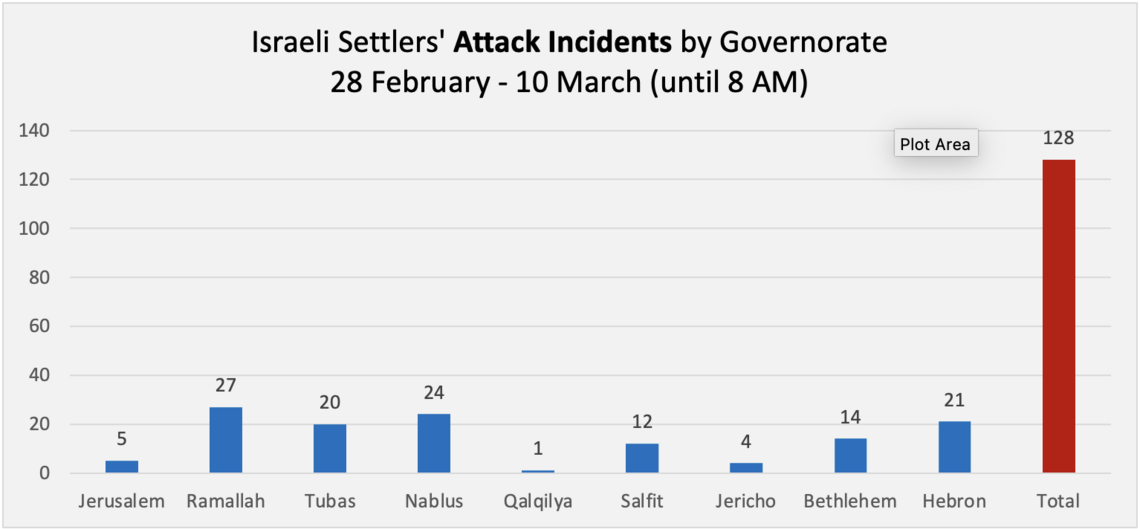
Since 28 February 2026, when Israel and the United States started the war on Iran, the West Bank, including occupied Jerusalem, has experienced significant terror attacks by Israeli settlers. These attacks have been marked by increased use of live ammunition, targeted violence against Palestinian civilians, and heightened coordination between settlers and Israeli occupation forces (IOF). With the imposed comprehensive military closure on West Bank governorates, the observed patterns suggest that settlers are exploiting the "fog of war" and the occupation authorities’ strict restrictions on Palestinian movement to intensify their assaults on Palestinians, continue carrying out forced displacements, and expand their hegemony over Palestinian land, resulting in multiple civilian killings, injuries, and extensive property destruction. In this regard, B'Tselem stated, "under the cover of war, the cooperation between the military and Israeli settler militias is deepening the ethnic cleansing of the West Bank." During the first week of the war’s outbreak, settlers, protected and supported by the IOF, carried out nearly 128 attack incidents[1], resulting in the killing of seven Palestinians and over 40 injuries. These injuries resulted from ten incidents involving gunfire targeting Palestinian citizens across the West Bank, including occupied Jerusalem.
I. Patterns of Israeli Settlers’ Terror Attacks
Analysis of recent Israeli settlers’ attacks reveals several recurring and alarming patterns
- Systematic Use of Live Ammunition: Israeli settlers employ lethal force against Palestinians through physical assaults, property destruction, and the shooting of unarmed civilians at close range. Documented incidents in Qaryut, Masafer Yatta, and Khirbet Abu Falah show that armed settlers frequently fire at defenseless Palestinians in the presence of the IOF or while under their protection, suggesting tacit approval by the IOF.
- Militarization of Settler Violence: Israeli settler reservists in army uniforms carry out night raids and attacks on Palestinian villages. According to the Israeli organization Yesh Din, over the past two years, incidents such as "shootings, violent assaults, trespassing, theft, and property damage" exemplify some of the offenses Israeli settlers commit against Palestinians behind the shield of "military-issued firearms and uniforms." Yesh Din noted that "the perpetrators were settler-soldiers on military duty who were abusing their authority, settler-soldiers on leave acting outside any official mission, or settlers in uniform acting on their own initiative." The conflation of settlers’ civilian and military roles leads to a lack of legal accountability, as their attacks are labelled as official "security" operations, thereby denying Palestinian victims access to legal recourse.
- Economic Strangulation and Threats to Palestinian Livelihoods: Settlers strategically target Palestinian farming communities, including in Masafer Yatta and the Jordan Valley. These attacks involve property theft and destruction, including attacks on water pipelines, and the prevention of shepherds from accessing grazing lands. The main goal of this pattern is to make life unbearable for Palestinians, forcing them to leave their homes and lands. According to a recent report by the Ministry of Agriculture, between 28 February and 5 March, the Palestinian agricultural sector suffered direct losses amounting to USD 614,059 as a result of attacks conducted by the IOF and Israeli settlers.
- Double Closure and Psychological Intimidation: Settlers have taken advantage of the IOF’s comprehensive military closure imposed since 28 February to siege and attack Palestinian villages and communities. Israeli settlers "have been closing roads and setting up makeshift checkpoints" at village entrances. Such measures aim to create a persistent atmosphere of psychological intimidation intended to undermine the resilience of the Palestinian people.
- Attacks on journalists and activists: In addition to several reports detailing the targeting of journalists who are trying to document settler attacks, Israeli settlers continue to assault and beat international solidarity activists, as happened in Duma village, to ensure that the attacks are carried out away from the eyes of the media and international monitoring.
II. Settlers’ Terror Attacks
Reporting Period: 28 February – 10 March 2026 [2]
During the reporting period, attacks by Israeli settlers resulted in the killing of seven Palestinians and injuries to 40 others, including four children and several international activists. Three roads leading to Palestinian communities were closed: the road to Khirbet al-Sidra in the Jerusalem Governorate, the road west of al-Mughayyir village in the Ramallah Governorate, and the road to Yarza village in the Tubas Governorate. Other incidents involved settlers using gunfire and pepper spray, chasing and severely beating Palestinians, throwing stones at vehicles on various roads and intersections, grazing livestock on Palestinian-owned farmland, damaging crops, and stealing or attempting to steal livestock.
Property damage was also reported, including land fencing in Umm al-Jamal village in the northern Jordan Valley. Such a method is employed to facilitate the further confiscation of Palestinian land. Additional attacks included the cutting of a water pipeline supplying drinking water to homes in Khirbet Yarza in Tubas Governorate and the killing of sheep in al-Rashayda village in Bethlehem Governorate. Also, cases of confiscation of citizens’ property and belongings were recorded, including the seizure of money and the theft of more than 150 livestock in the village of al-Aqaba in Tubas Governorate.
Furthermore, ongoing attacks and threats by Israeli settlers, supported by the Israeli occupation authorities, aim to displace Palestinians and replace them with more Israeli settlers to extend control over Palestinian land. According to information from the Colonization and Wall Resistance Commission, four communities were forcibly displaced in the past ten days, affecting 37 families comprising 191 people, including 65 women and 106 children:
- Khirbet Yarza in the northern Jordan Valley (on 8 March): 11 families were displaced, totaling 69 people, including 21 women and 40 children.
- Al-Aqaba/East in the Jordan Valley (on 7 March): Nine families were displaced, totaling 38 people, including 14 women and 16 children.
- Shakara (near Duma village), Nablus Governorate (on 6 March):13 families were displaced, totaling 59 people, including 19 women and 35 children.
- Arab al-Zawahreh, Nablus Governorate (on 5 March): 4 families were displaced, totaling 25 people, including 11 women and 15 children.
A. Details of Settlers’ Terror Attacks
By Governorate
- Jerusalem: Israeli settlers’ attacks included road closures and movement restrictions, physical assaults, attacks on livestock infrastructure and property, and attempts to target Palestinian vehicles. The incidents resulted in property seizures, attacks on sheep pens, injuries to one Palestinian citizen, and livestock fatalities. Most of these attacks targeted Bedouin communities around Mikhmas and Jaba, emphasizing mobility restrictions, harassment of Palestinians, and assaults on their livelihoods, especially livestock-related facilities.
- Ramallah: Israeli settlers’ attacks included frequent stone-throwing and assaults on Palestinian vehicles, attacks on farmers and shepherds on agricultural land, livestock theft attempts, grazing on private Palestinian land, and road closures and intimidation tactics around villages. The incidents resulted in the killing of three Palestinians in Khirbet Abu Falah, the injury of at least four others, property damage to vehicles, and repeated livestock-related violations. The Ramallah Governorate faced systematic harassment in rural communities, particularly shepherds and farmers in Al-Mughayyir, Silwad, Sinjil, and nearby villages. The deadliest incident occurred in Khirbet Abu Falah, involving the use of gunfire and the IOF intervention.
- Tubas: Israeli settlers’ attacks included assaults on shepherds and Bedouin communities, livestock theft and destruction, land seizure attempts (fencing private land), water infrastructure sabotage, road closures, and harassment during grazing activities. The incidents resulted in the spraying of five Palestinians with pepper spray, two injuries, the theft of sheep, forced displacement, and the cutting of a water pipeline. Tubas Governorate witnessed intensive pressure on Bedouin and pastoral communities, particularly in Ras Al-Ahmar, Khirbet Yarza, and Khirbet Al-Aqaba. The incidents show a pattern of economic targeting (livestock theft, water disruption) combined with coercive displacement tactics.
- Nablus: Israeli settlers’ attacks included armed assaults using gunfire, forced displacement, assaults on Palestinian citizens and international activists, attacks on homes and infrastructure, as well as robberies and vehicle attacks. These incidents resulted in the killing of two Palestinians in Qaryut village, five injuries (including two international activists), along with theft of money and property damage. In the Nablus Governorate, Israeli settlers used intense violence and lethal shootings, especially around Qusra, Qaryut, and Duma.
- Hebron: Israeli settlers’ attacks included physical violence against shepherds in Masafer Yatta, the use of gunfire, attempts to steal livestock, and assaults on homes and citizens. These incidents resulted in the killing of two Palestinians, several injuries (including three children shot), and livestock theft incidents. The Hebron Governorate recorded some of the most serious armed incidents, particularly in Masafer Yatta, where attacks appear focused on forcing shepherd communities away from grazing lands.
- Jericho: Israeli settlers’ attacks mainly targeted agricultural livelihoods, including livestock facilities and agricultural property, as well as settlers grazing their livestock on Palestinian farmland. These incidents resulted in damage to agricultural property.
- Bethlehem: Israeli settlers’ attacks included livestock grazing on Palestinian farmland, attacks on homes, and shooting incidents affecting livestock. These incidents involved sheep being killed by gunfire and caused damage to residential properties. They primarily occurred around Rashayda, Kisan, and Al-Minya, indicating pressure on rural and Bedouin communities reliant on agriculture and livestock.
- Salfit: Israeli settlers’ attacks included physical assaults on farmers and landowners, attacks on homes and vehicles, and harassment in agricultural areas. As a result, several Palestinians were injured, including one who was severely beaten (resulting in broken legs), and property damage to vehicles and homes. The incidents were concentrated in Deir Ballut, Bruqin, and the surrounding agricultural areas.
B. Palestinians Killed Since 28 February 2026
Details of the Israeli attack incidents that led to the killing of seven Palestinians
- On 28 February 2026, Tamer Qaisiya, a 19-year-old resident of Al-Dhahiriya (Hebron Governorate), succumbed to critical injuries sustained when he was shot by settlers in the Umm Qussa area of Masafer Yatta on 25 February 2026.
- On 2 March 2026, a group of settlers entered the eastern area of Qaryut village (Nablus Governorate) and opened fire on Palestinian citizens, resulting in the martyrdom of two brothers: Mohammad Muammar, 25 years old, and his brother Fahim, 47 years old. Three other Palestinians were wounded.
- On 7 March 2026, a group of settlers in the Wadi Al-Rakhim area of Masafer Yatta (Hebron Governorate) opened fire on Palestinian shepherds while they were herding sheep, resulting in the martyrdom of Amir Shanaran, 27, and wounding his brother Khalid.
- On 8 March 2026, a group of settlers under the protection of the IOF attacked the village of Khirbet Abu Falah (Ramallah Governorate), opening fire on Palestinian citizens. The IOF intervened, firing live ammunition, rubber-coated bullets, stun grenades, and tear gas at them, resulting in the killing of three Palestinians: Thaer Hamayel, 24 years old; Farea Hamayel, 57 years old; and Mohammad Murra, 55 years old, who died from tear gas inhalation, which caused cardiac arrest before reaching the hospital. Four others were wounded: Muath Al-Khatib, Jihad Murra, Zaid Hamayel, and Fadi Nazzal.
Conclusion
Israeli settler attacks in the West Bank, including occupied Jerusalem, show patterns of organized terror as opposed to isolated incidents. In their recent report on the situation in occupied Jerusalem, UN experts stated that "irreparable harm is being inflicted on Jerusalem, as violence engulfs the region, and genocide continues in Gaza and spills into the West Bank." The experts warned that "these acts must be understood in their totality: the ethnic cleansing of Palestine (...) this environment is coercing Palestinians to leave their homes and life in a city where their roots run deep."
Several international bodies, including the UN, issued warnings about the risks associated with attacks by Israeli settlers. UN spokesperson Stephane Dujarric emphasized that "operations and violence by Israeli settlers and security forces are ongoing," noting that such violence is causing "casualties, damage, and forced displacement" of Palestinians. He added that the increased closures of Israeli checkpoints and road gates continue to "restrict Palestinians’ access to services and workplaces." Emergency services and humanitarian efforts are also being affected. Additionally, the World Health Organization reported that recent checkpoint closures and movement restrictions have hindered medical teams from reaching Palestinian patients promptly, endangering many lives.
The people of Palestine, particularly in villages and Bedouin communities, face continuous risks of forced displacement and transfer and loss of their livelihoods mainly due to Israel’s colonial settlement enterprise, land confiscation, settler violence, and movement restrictions. Evidently, the current extremist Israeli government appears to be making use of the focus on the war on Iran to establish additional illegal facts on the ground in occupied Palestine.
[1] Multiple attacks may occur in the same incident
[2] PLO-NAD/ The Palestinian Monitoring Group, Daily Violations Reports, Available in Arabic.